The am Locus
Symbol: am
Also known as: Amputated locus
Sources: Hollander and Miller 1978: “Amputated, frayed, and sideburns; three new mutants in the pigeon”
Function
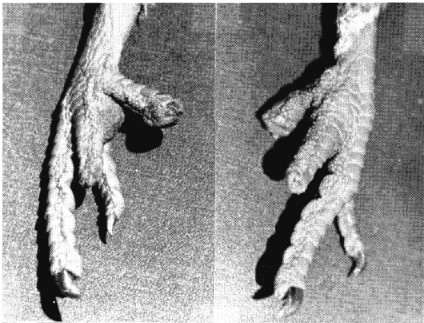
A locus associated with a variable congenital reduction of distal structures, most commonly affecting the toes/claws, sometimes the digits of the wing, and more rarely the lower beak.
Alleles at this locus
am– Amputated (mutant)am+– Wild type (normal)
Inheritance
Autosomal recessive, with reduced penetrance / variable expression.
Key breeding observations in the Hollander and Miller paper:
- Matings of defective birds to normals produced 30 F1, all normal, and sex linkage was considered excluded (e.g., daughters of an abnormal male were normal).
- The authors treat it as simple recessive inheritance, but note that the results depart from ideal Mendelian expectations, consistent with reduced penetrance and/or classification ambiguity in mildly affected birds.
Primary genetic effects
Most common presentation: the inner toe (second digit) of one or both feet lacks the claw and may be reduced to a stump; severity ranges from very mild to affecting most toes.
More severe presentations: abnormalities of most/all toes, reduction of the digital portion of the wing, and occasionally shortening/defect of the lower beak (including at least one very abnormal young that could not hatch due to only a rudiment of the lower beak).
Genetic interactions
No specific epistatic interactions are established. The authors suggest that genetic modifiers and environmental variables (especially incubation conditions) may influence expression/variability, and also note that some mildly affected birds may have been misclassified as normal in early tests.
Linkage
No known linkages.
Associated genes / alleles
- Amputated (
am)
Phenotypes influenced
- Amputated
Notes and uncertainty
- The authors explicitly state it remains to be determined whether the mutant reflects true “amputation” of embryonic structures vs growth inhibition, pending further embryological study.
- Expression is described as wide and seemingly erratic, consistent with reduced penetrance/variable expressivity.